Sunday, March 18, 2012

Şehitlik-Moschee - Berlin, Neukölln

http://www.moscheeteam.de/bilder.php
Foto: Steffen Pletl, via http://www.morgenpost.de/
Today Michael and I participated in a tour of Neukölln's Şehitlik mosque, the largest mosque in Berlin, which belongs to the Turkish-German community. We bike/jog by here all the time, but had never been in (and didn't even know whether it was possible to visit). So when Fulbright listed it as one of the possible free tours offered as part of their annual meeting, we definitely wanted to sign up.

On the website of the mosque (and also here) you can also find out more information about visits.

They list the following reasons for wanting people to visit:
  • Islamische Architekturkunst aufzeigen und erläutern [show and explain Islamic architecture]
  • Muslimisches Leben im Berliner Alltag vorstellen [introduce Muslim everyday life in Berlin]
  • sich gegenseitig kennenlernen [get to know one another]
  • Vorurteile abbauen und Gemeinsamkeiten entdecken [break down stereotypes and discover commonalities]
  • Steigerung gegenseitiger Wertschätzung [increase appreciation of one another]
  • Fragen (auch kritische) zum Islam authentisch beantworten [answer (also critical) questions about Islam in an authentic way]
  • Perspektivwechsel ermöglichen [make possible the exchange of perspectives]
  • Dialoge und Freundschaften fördern [promote dialogue and friendships]
Foto: picture-alliance/ dpa (welt.de)
We learned that there are about 300,000 Muslims in Berlin, and about 80 mosques and/or prayer rooms. Most are the so-called "Hinterhofmoscheen", or "courtyard-mosques," hidden away in apartment buildings. There are no outer signs that there is a mosque there. Only a few are free-standing buildings, visible as mosques, and this is the largest. Our guide told us that the Muslim community in Berlin is very ethnically divided, so you have a Turkish mosque, a Bosnian, an Arab mosque. He also said that there is no official organization, with a "head" of the Muslim community in Germany. This is difficult because in Germany there is no real separation of church and state, and without this kind of organization, the Muslim community cannot get the equivalent of the Christian "church taxes," or religious education in the schools. (In German schools, kids have to have either "religion" class (Protestant or Catholic), or they take "ethics." There is no option for Islam.)

This mosque is very new: finished in 2005. It was built to resemble Ottoman mosques in Turkey from the 16th and 17th centuries, with the minarets. This mosque was built on a piece of ground that actually belongs to Turkey. Back in the days of Prussia and the Ottoman empire, the Prussians gave the Turks this piece of ground for a cemetery, and the mosque is built on this piece of land.

In this particular mosque, the prayer is read in Turkish (sometimes also Arabic), but the Friday sermon is read in German. We got to sit in and listen/watch a prayer service. It lasted about 10 minutes and the prayer was more sung than read. The men and women were separated, the women prayed in the balcony (where we also sat). The men prayed with the imam below. It's a very physical way of praying. They kneel down, sit on their heels and touch their forehead to the ground, and repeat this motion. Their bodies are very close, and at the end of the ceremony they all moved towards the front, and made sure everyone in each row was touching, so no one stood alone. Our guide explained that for this reason men and women are also separated, because when you bow down your head is very close to the rear of the person in front of you.

It's not only a place of prayer, but a community center. While we were there, there were constantly children running around. I noticed a few men holding cups of tea when we came in, and women sitting around in the courtyard talking. Michael also pointed out to me they have a Reisebüro, travel agency. The woman from the board of the mosque as well as the imam came to us and introduced themselves.

Saturday, March 17, 2012

strahlender Sonnenschein auf dem Tempelhofer Feld


It's 20 degrees Celsius today (68 F) and people are out enjoying it. Michael is playing basketball on an outdoor court, I went for a jog at Tempelhof and took a camera along. People were loving the weather. Thousands of Berliners escape their dreary cold apartments and get out to the parks. They were biking, roller blading, jogging, walking their dogs, playing frisbee, skateboarding, flying kites and doing those kite/skateboard with wheels thing. Playing catch, reading, walking, playing with remote-control cars. You name it. As I left the park, more people were coming with bags of beer and picnic stuff, lots of people were already starting to grill. Summer in March? I'm Minnesotan...can't be fooled. But it sure does feel good. :)

Friday, March 16, 2012

my quiet little Sinfonie der Großstadt

Today was such a gorgeous spring day, and although I was stuck in the archive for most of it, I took some movie shots for a change on my way home. I was inspired by Sinfonie der Großstadt to take some pictures of people moving around...by tram, train, bike, foot and bus. It's not our neighborhood, or even very scenic areas of Berlin, but it's my first try at video...so maybe I'll get better. :) Hope you enjoy! If you have any recommendations...things you'd like to see, let me know!

Thursday, March 15, 2012

halal meat or headscarves (or: non-American electoral campaigns)

Anna Maria Jakub/Getty Images, http://www.npr.org/
It's easy to forget with all the hullabaloo about the Republicans right now...but the US is not the only country that finds itself in the middle of an election year, and a big one. France's Nicolas Sarcozy is up for re-election this year, and is currently trailing the Socialist Francois Hollande, but it's close. (Remember Dominique Strauss-Kahn? who was a favorite to run against Sarkozy until his little hotel fiasco?)  In third, on the far right, is Marie Le Pen, from the National Front (like a smarter, but crazier Sarah Palin: a fresh female face for the far-right party). In France they have two rounds of elections. The first is in May, where they pick the top two candidates to move on.

France has some interesting politics... I am always interested in following this conservative, xenophobic strain in European rhetoric of "heritage" "[French]ness", "culture," national identity and the issue of immigration. In the last few years, these topics materialized in the form of the headscarf debate. And in France it's especially complicated because of their alleged separation of church and state (laicité), one of their founding myths as a nation, and their complicated history of colonialism, and growing Muslim population. Since April 2011, France has banned the burqa, under the rationale that they are protecting women's rights. (It is estimated that only about a few hundred women even wear the burqa, so it says something more about French fears than about headscarf-wearing in France.) Back in 2004, they banned all religious symbols from schools, in an attempt to remove the headscarf from schools (cross necklaces, for example, are seen as subtle and unproblematic). So with all this in mind I heard a story on NPR yesterday about how the latest issue in France is the butcher shop, or rather, halal butchering of meat.

Halal meat is meat that was butchered according to Islamic law, where the throat of the animal is cut and the animal bleeds to death. (According to European law, the animal must be dead before it is slaughtered.) So it turns out, in most French butcher shops around Paris, they don't want to lose their Muslim customers. So they have been slaughtering all their meat this way, and not publicizing this fact, but selling both "halal" and "regular" meat. You can imagine the reaction on the Right when this news came out...
Marie Le Pen

"I have the right as a citizen to know if I'm buying meat where the animal is slaughtered in horrible cruelty, taking sometimes 15 minutes to die," said Le Pen. "This is a moral point. Don't French people who don't want to eat halal have the same rights as Muslims who do?" [from NPR]

And then Sarcozy called for stricter meat labeling, and the Prime Minister Francois Fillon took it a little farther...  "Speaking on Europe 1 Radio, Fillon suggested that Muslim and Jewish ancestral ritual slaughter traditions were outdated. 'Religions should think about continuing to keep traditions that don't have much in common with today's state of science or hygiene,' he said." Article at NPR
 In reaction, French Jews and Muslims came together to protest the comment, and Sarkozy may have ended up losing some supporters.

Oops, this post got a little long...I just thought the issue was fascinating...I'm not going to comment too much, other than to say that although immigration is a topic in the US, in Germany, in France...it definitely manifests itself in different ways in our various countries, and I thought this was an interesting little window into French issues right now. Sarcozy has also spoken of tightening France's borders, which could be a whole different topic...

Tuesday, March 13, 2012

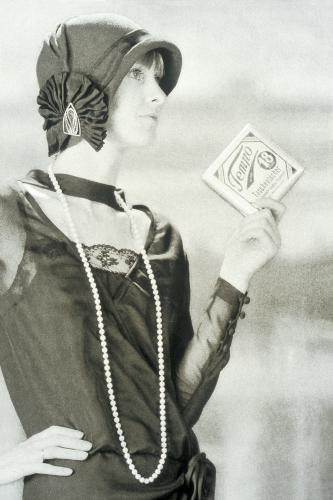
Ode to Tempo Taschentücher

Berlin, 1929, an early ad
 So for the last two weeks I've had a bad cold on-and-off, so I thought I would do a strange little post about the German version of Kleenex, called "Tempo" (but superior to its American version). Like in English, people reference the thing by the brand name (Kleenex/Tempo) maybe just as often as the generic word "tissue" or "Taschentuch".

A cultural difference (but correct me if I'm wrong): My impression is that in the US, people tend to buy boxed tissues more than the small kind. If you go to a drugstore or grocery store, there is a whole shelf with lots of options for boxed tissues: colored tissues, with lotion, with aloe, etc. But Germans have mastered the pocket tissues. But the pocket sized ones are usually flimsy and cheap in the US, and the German ones are super strong. And, in Germany almost everyone always has a pack of tissues on them, that look like the blue pack below.

It's funny if you think about the cultural meaning of this revolution: from fabric handkerchiefs to paper tissues (diapers, too...). In Germany this brand was introduced in 1929; in the US Kleenex was also being developed and marketed in the mid 1920s. At first it was being used to remove makeup, and then after the 30s it is marketed as a hygiene product, with the slogan: “Don’t Carry a Cold in Your Pocket”.  Below is a similar ad/slogan from Tempo: "Higher Risk of Flu - Tempo, the hygienic tissue. " (here More ads from Spiegel)  So that's the weird little post for you as I sit in bed, recovering with my Tempos. :) Germany isn't the worst place to have a cold...as they also have the best juice (Multivitaminsaft) and Ricola! (Jessica knows what I'm talking about here...)


Friday, March 9, 2012

an die Arbeit!

I'm stepping up my work schedule a little bit...sorry for the irregular posting. When March hit, it was a bit of a wake-up call that summer is just around the corner, and we have lots of visitors coming in the next few months. So I'm trying to schedule archive visits, and library time to make the most of my sojourn in Berlin. And training for the Berlin half marathon (3 weeks!), plus life on top of it all. :)

Tuesday, March 6, 2012

Berliner Landschaften - WWII Bunker


One of the things I love about Berlin is how many little pieces of history you discover walking/biking/running through the city. It's fascinating, and the city never lets you forget that it has this multi-layered history that never goes away. Today biking home I went by this apartment complex which was built over/above/around a WWII bunker that was impossible to get rid of after the war (the amount of explosives it would have taken would have destroyed too many of the surrounding buildings).  Most were destroyed by the Allies. This older post from a few summers ago also has a bunker that survived the war, in Mitte near the Deutsches Theater. There is an organization (Berliner Unterwelten) that does tours of bunkers and other "underworlds", but I have never done one. Maybe when Anna and Paul come to visit this summer we'll do it. Their website also has some good information about the various sites they go to. For example, in the Volkspark Humboldthain, the bunker was also too close to railroad lines to be destroyed, so they piled it with rubble and it created a so-called "Trümmerberg", rubble mountain. In this case, it was over 1,4 Millionen cubic meters of rubble! There are many of these "Trümmerberge" in Berlin, formed after the war when they were trying to rebuild and reorganize the city from the pile of bricks it was. The most famous is the Teufelsberg, which I have also not yet visited, in the Grünewald. Some of the U-Bahn stations also had bunkers, like Gesundbrunnen, and under Moritzplatz.  

from: www.berliner-unterwelten.de

Monday, March 5, 2012

some U-Bahn history

One thing I always love about being in Europe are how the street names (and U-Bahn station names) are always tied to history, culture, and geography. It's not 5th Ave and 10th Street, random numbers and coordinates like on a US city grid, but "Rosa-Luxembourg-Platz" and "Kleistpark," "Straße des 17. Juni" and "Bismarckstr.". (This has always impressed me in visiting, Paris, too.) And sometimes, with the ups and downs of history, the street names change. The Third Reich is only the most obvious example: Rosa-Luxembourg-Platz was "Horst-Wessel-Platz"; Theodor-Heuss-Platz was Adolf-Hitler-Platz 1933-1945.

Michael noticed that one of our regular stations, Platz der Luftbrücke, has a plaque that the station used to be called "Kreuzberg" (see picture above). Well, it's obvious that the name "Platz der Luftbrücke" [the Berlin Air Lift] is a relatively recent name. So I looked into it...and found this amazing website, http://www.alt-berlin.info  with great old maps of the city. The history of the U-Bahn is relatively recent but they have maps of the city going back to 1738.  Here is another super amazing (I know, so nerdy...) site with info about all the stations: http://www.untergrundbahn.de/, and even some historic pictures.


So you can see above the station is called "Kreuzberg", you can also see the Viktoria Park. And in the map below from 1926, the stop is marked with an open circle (incomplete?). In the last one below, it's already renamed "Flughafen" (Airport).
1926
1939
Hallesches Tor - today and before the war

Saturday, March 3, 2012

these Saturday mornings are the best

 I woke up to blue skies, and went down to the market. It's the best part of living where we do: the weekly Saturday morning organic market is literally outside the door. I got some fresh eggs, bread from the baker, onions, and spinach. And I got some nice honey and homemade jam as a treat. :)

When I got home, I roasted butternut squash, sunchokes, onions and garlic, pureed them all (I love my immersion blender so so much), and now they are simmering on the stove for some afternoon soup. Yum. I am excited for spring...but making the most of the wintery veggies we have.

Unfortunately the market is in the shadow of the buildings to the east, so it's hard to show how beautiful this day is looking. Spring flowers are starting to come to the florists, and people are getting out more. I love living in Berlin!


Recipe: Sunchoke-Squash Soup
one large onion
one head of garlic (yes...)
smallish butternut squash
2 lbs sunchokes 
1/2 cup cream
1 cup stock/water
juice of half lemon
salt/pepper

1. Prepare a cookie sheet with parchment paper. Cut 1/2 inch off head of garlic. Cut squash in half lengthwise, scoop seeds out. Wash sunchokes and cut into 1/2 inch pieces. (many American recipes say to skip the peeling part but wash well. they are so weird and knobby-shaped it definitely makes things easier, but you end up with small, potato-like skins in your soup. pros/cons...I left the skins on). Toss everything with a little olive oil, and ROAST all this stuff in the oven 45 mins (squash skin-side up, garlic open-end exposed).
2. When soft, throw it into a pot, thin with a little water or stock, and puree. Stir in cream at end and season with salt/pepper. The roasted garlic is amazing, and the lemon juice really adds something, too. I didn't get quite the consistency I wanted. If I did it again, I would maybe saute the sunchokes with the onion until soft, but roast the squash and garlic, and then add everything together and puree. The sunchokes were still a bit hard (you can see the not-so-smooth texture in the picture), but still delicious.

Thursday, March 1, 2012

Minnesota gets snow, we get clouds (big surprise)

dpa: http://www.berliner-zeitung.de/berlin,10809148,11237280,item,1.html