Monday, November 14, 2011
Mitte, nachts
We don't really see the "touristy" sights of Berlin very often, but when we went to the theater on Saturday night we got to see some of the buildings lit up...It felt good to get out of Kreuzberg, our neighborhood, and be in the middle of Berlin. They are starting to set up the Christmas Markets!
Sunday, November 13, 2011
citizenship: members of a soccer team for life
A quote I wanted to share from Wolfgang Koeppen's modernist novel Tauben im Gras, which I read recently. This made me think about the American ambassador's speech and about national alliances, and all our other alliances that sometimes pull us in different directions. The novel was written during the first years of the Cold War and takes place in one day in Munich, constantly shifting perspectives between American occupying soldiers and Germans.
Die offizielle Welt bemühte sich noch immer, in hohlen Phrasen zu denken, in längst jeden Begriffes baren Schlagworten. Sie sahen feste, unverrückbare Fronten, abgesteckte Erdstücke, Grenzen, Territorien, Souveränitäten, sie hielten den Menschen für ein Mitglied einer Fußballmannschaft, der sein Leben lang für den Verein spielen sollte, dem er durch Geburt beigetreten war. Sie irrten: die Front war nicht hier und nicht dort und nicht nur bei jenem Grenzpfahl. Die Front war allüberall, ob sichtbar oder unsichtbar, und ständig wechselte das Leben seinen Standort zu den Milliarden Punkten der Front. Die Front ging quer durch die Länder, sie trennte die Familien, sie lief durch den Einzelnen: zwei Seelen, ja zwei Seelen wohnten in jeder Brust, und mal schlug das Herz mit der einen und mal mit der anderen Seele.
The official world was still attempting to think in empty phrases, in key words…They saw steadfast, unmovable fronts, demarcated pieces of earth, borders, territories, sovereignties, they took people to be members of a soccer team, who should play their whole lives for the team they joined by birth. They were wrong: the front was neither here nor there and not only at the borders. The front was everywhere, whether visible or invisible, and life was constantly changing its position to the billion points of the front. The front cut across countries, it divided families, it ran through the individual: two souls, yes two souls lived in each chest*, and sometimes the heart beat for one and sometimes for the other soul.
*”zwei Seelen in einer Brust” is a reference to Goethe’s Faust
Labels:
books
Friday, November 11, 2011
Gemüsekiste: farm share boxes in Germany
So I ordered a trial farm share box for this week, a Gemüsekiste from a farm west of Berlin. In Germany they seem to do these boxes much differently than in the US.
In case you're not familiar with the "CSA" system in the US (which I only know through friends who have done it), the typical farm share is a mix of vegetables in season from local farms. You don't choose what you get; you have to get creative with what's in season. You can choose between a "whole share" or a "half share" and it's usually available once a week, you pick up at the farm or at the farmer's market.
In Germany, this works differently. You can pick individual items, and you seem to have more flexibility with how much you get and how frequently. In looking into this for Berlin, I found about 4-5 different farms to choose between, all with websites where you could order online. Online shopping for veggies! One kilo of potatoes, some mache greens, into the "shopping cart." Or you can choose a mixed box, with the options of fruit/veg mix, just veggies, regional veggies, etc. Then you decide whether you want 10 EUR, 15 EUR, or 20 EUR worth of veggies (for example). So it seemed more flexible in terms of price and size. You could also choose between weekly delivery and every-other-week delivery. Some sites offered regional produce, or produce from their own farm, others put together boxes from different farms, and even include "exotic" organic produce from outside of Germany. So you can opt for a box that includes organic bananas and avocados, or one that is from the farm's own harvest. Often you can also add non-produce products as well. You can have them add in a "cheese of the week" or "bread of the week" or milk with the delivery, among many other items.

I found one site that looked like a good one to try. Their website wasn't as good as some of the others, but they have quite a few things from their own farm, and they offered a "trial box". Rather than order individual items, I just told them to put together a selection for 16 EUR, as much stuff from their own farm as possible. This is what we got: Rote Bete, Möhren, Mangold grün, Kartoffeln festkochend, Pastinaken, Knollensellerie, Weißkohl, Posteleinsalat, Äpfel Cox Orange, Spaghettikürbis. Okay, although you might not understand all the German, I am sure there are also some things in this picture you don't recognize. We had to look up: Pastinake = parsnip, Knollensellerie = celery root. So if you have ideas about what to do with these things, I will welcome any advice. The spaghetti squash is exciting. :) And I love the tasty little apples. They never taste that good from the supermarket!
I don't know if I'll sign up for regular delivery. It's a bit expensive (16 EUR for the above pictured), and there is a weekly organic market right around the corner. But I wanted to just try it out and see what it's like.
In case you're not familiar with the "CSA" system in the US (which I only know through friends who have done it), the typical farm share is a mix of vegetables in season from local farms. You don't choose what you get; you have to get creative with what's in season. You can choose between a "whole share" or a "half share" and it's usually available once a week, you pick up at the farm or at the farmer's market.
In Germany, this works differently. You can pick individual items, and you seem to have more flexibility with how much you get and how frequently. In looking into this for Berlin, I found about 4-5 different farms to choose between, all with websites where you could order online. Online shopping for veggies! One kilo of potatoes, some mache greens, into the "shopping cart." Or you can choose a mixed box, with the options of fruit/veg mix, just veggies, regional veggies, etc. Then you decide whether you want 10 EUR, 15 EUR, or 20 EUR worth of veggies (for example). So it seemed more flexible in terms of price and size. You could also choose between weekly delivery and every-other-week delivery. Some sites offered regional produce, or produce from their own farm, others put together boxes from different farms, and even include "exotic" organic produce from outside of Germany. So you can opt for a box that includes organic bananas and avocados, or one that is from the farm's own harvest. Often you can also add non-produce products as well. You can have them add in a "cheese of the week" or "bread of the week" or milk with the delivery, among many other items.
I found one site that looked like a good one to try. Their website wasn't as good as some of the others, but they have quite a few things from their own farm, and they offered a "trial box". Rather than order individual items, I just told them to put together a selection for 16 EUR, as much stuff from their own farm as possible. This is what we got: Rote Bete, Möhren, Mangold grün, Kartoffeln festkochend, Pastinaken, Knollensellerie, Weißkohl, Posteleinsalat, Äpfel Cox Orange, Spaghettikürbis. Okay, although you might not understand all the German, I am sure there are also some things in this picture you don't recognize. We had to look up: Pastinake = parsnip, Knollensellerie = celery root. So if you have ideas about what to do with these things, I will welcome any advice. The spaghetti squash is exciting. :) And I love the tasty little apples. They never taste that good from the supermarket!
I don't know if I'll sign up for regular delivery. It's a bit expensive (16 EUR for the above pictured), and there is a weekly organic market right around the corner. But I wanted to just try it out and see what it's like.
Thursday, November 10, 2011
die Freie Universität Berlin
The Freie Universität, in German FU (eff-uuh), lovingly called the "eff-you" by some Americans... This is our "host" university in Berlin. Michael has been attending a few courses regularly, and we have been trying to work in the library here, too. It's a 30-45 min commute, way out in Berlin-Dahlem, where the Americans were stationed at the end of the war. The name, the "free" university, refers to the postwar ideals of freedom and liberty and democracy promoted in Germany by the liberating occupying forces.
Labels:
uni
On bibliophilia, and why I want a Kindle for Christmas
I've always been one of those people resisting the growing e-book market. But tonight I went to a talk that gave me some really interesting things to think about...First, some reflections about books and reading, and the future of books and reading.
My mother passionately loves books and loves to read, I grew up with classic stories and with local treasures, and these memories are always with me. My dad introduced me to the adventures of Jack London, and his parents have a library which is a truly magical place. And there have been many days when my sisters have stayed in bed all day with a book, and when we have fought over whose turn it was to get the next Harry Potter.
I love the weight of a book in my hand, I like the excitement when you can feel that there are only a few pages left to turn. I like to collect books and own them, see them on my bookshelf and think about where those books have brought me. Unlike my sister E, who is a true bookworm, I don't usually re-read books, but I still like to have them. Sometimes I do feel that it's more a kind of collecting. The books take on a different function when they enter the bookshelf. And there are different kinds of reading...Now that I am a full-time, eternal student and teacher, I read differently, and I read different kinds of texts differently. I still love to consume a good novel, and be driven by a story, but I also enjoy the different pace and challenge of a difficult poem or story.
Also, the places of reading are amazing places. I had an earlier post about libraries in Berlin, but also independent bookstores, and even bigger chain bookstores. I was really really sad to see the downtown Borders close in Ann Arbor, the site of the first Borders, and subsequently see the whole chain follow.
So all of these thoughts and memories and feelings were already a part of my experience when I went to this evening's talk, entitled "Was ist das Wesen des Buches?" (roughly) "What is the book?" (The German word "Wesen" means nature/character/essence), and with the subtitle "Ruth Klüger: Reading Differently, Confessions of an avid e-book reader". Ruth Klüger is a German-American academic and author, most famously of the book weiter leben (Still alive).
Some background info: Germany does not at all have the e-book culture that is growing steadily in the U.S. Surprisingly, I have yet to see someone reading an e-book on the subway, or in public in general. Always newspapers and paper books. Also, Germany has many more independent bookshops. They do have a few big chains, but also lots of little Buchhandlungen.
Ruth Klüger, the invited speaker, talked about how popular e-books have become in the US, especially among older people, because you can adjust the font size, and they are easy to hold and comfortable to lug around with you. She talked about the ease of ordering books with one click after reading an interesting review, and how she reads more books more quickly with the e-reader. She talked about how e-books are less expensive and some, out of copyright, are even free. She attributed the popularity in the US in part to the fact that we have a "Wegwerfgesellschaft", a "culture of throwing things out/away". She said, people in the US tend more to pass on or get rid of books they have already read, rather than hold on to them, put them in a library. (This Wegwerfgesellschaft, in general, describes the trend to throw things out instead of having them replaced, use plastic dishes, etc, which is, in general, true, I would say, of our culture.) There was also a publisher present who has a hybrid traditional/e-book publishing house, who also commented and answered questions. In general, all of the comments presented by the panel discussed the growing trend towards e-books as an unstoppable trend which is not going to make paper books disappear, but which will be a somewhat parallel development. It was not completely pro e-book, but did make arguments for their usefulness, for their place in reading culture.
Then the debate began (Q&A session). Interesting. And made me increasingly angry. What disturbed me most was the way Germans talked about the US and the tone of some of their remarks, with an air of superiority, arrogance, and discomforting nostalgia. (I'm all for critiquing the US, just as I can critique German culture, but what gets to me is the arrogant tone. It makes me defensive.) If you've read this far, you can see that a big part of me also wants to attack e-books and hold out for the experience of holding a real book in your hand. But when I heard people making their arguments, I wanted to be more open about these changes. Here are some of the more impressionable remarks:
1. One guy brought up the comment about America's "Wegwerfgesellschaft" and talked about how nice it was to own keep books (again, in a slight tone of arrogance about Germans vs Americans). Now, I am an avid book-collector. But I will admit, sometimes it gets out of hand. How many of the books on my shelf have I read? How much has it cost to acquire this collection? Books can also become a fetish, and buying them can also be a bit obsessive. It's also a marker of social class, and of education. Someone brought up how it's a part of a certain kind of living/household aesthetic, to have big, filled bookshelves. In Germany there is this idea of the Bildungsbürgertum, the educated bourgeoisie, that has more of a (classed) tradition than in the US. Owning bookshelves is a kind of status symbol. Once I heard about someone (a famous writer maybe?) who would leave a book in public somewhere every time he finished reading it, hoping someone else would pick it up and enjoy it. The idea stuck with me. How liberating! How would that lighten the load of earthly possessions you have! Ruth Klüger mentioned that houses in the future will look differently, that the e-book industry will impact the way we collect, own, and display books. Maybe she will be right. Maybe it has already started?
2. One student talked about how Germans should be proud that they have held out against e-books, that they, and Europeans in general still have a book culture, and still read real books. She also made some remark about how the German language is dying out anyways being influenced from English. I kinda wanted to yell at her. (But didn't, decided to blog instead. hehe) First of all, this talk of "culture" and "European culture" and "heritage" is a very specifically classed (and privileged!) culture. It is not all Europeans that are collecting massive libraries. Second, while it is true that German incorporates quite a few English words in technological fields (das Internet, der Computer, die Email, das E-Book), by and large it is not being affected by English. Not any less than it has been, at other times, fashionable to throw in French words. This whole discussion was very German in German German, and would not have been understandable to an English, non-German speaker! The publisher had a great response to this comment: "I'm going to answer a bit polemically...sorry, but we are always 4-5 years behind the US. In a few years, we too will have e-books making up a large amount of the book market..."
There were other comments, about whether reading on an e-reader changes the experience of reading (best point), and how books connect us to memories and to family members who have passed them down to us (this will also probably trickle out...). About how this makes reading more affordable for students, whether academic texts will be published as e-versions, whether instructors will assign electronic books in class some day (the audience laughed, but in Michigan I heard that our German textbook will soon be printed electronically!).
Throughout, I couldn't help but think about how many different kinds of reading there are. There is reading in the subway on your daily commute, there is reading in bed before sleep, there is with a pen and notepad in the library, there is all-day-Sunday-afternoon reading, there are Jane Austen novels and Harry Potter fantasy stories and classic literature and poetry... And although I will never stop buying books, adding to my impossible collection, and and mourning the loss of local bookstores, I think it might be nice to get some Kleist, or Dickens (for free!) on an e-reader for my next trip across the ocean. Or maybe even for my next U-Bahn commute.
Do you have an e-reader? How would you describe "American" reading culture? I welcome your comments!
My mother passionately loves books and loves to read, I grew up with classic stories and with local treasures, and these memories are always with me. My dad introduced me to the adventures of Jack London, and his parents have a library which is a truly magical place. And there have been many days when my sisters have stayed in bed all day with a book, and when we have fought over whose turn it was to get the next Harry Potter.
I love the weight of a book in my hand, I like the excitement when you can feel that there are only a few pages left to turn. I like to collect books and own them, see them on my bookshelf and think about where those books have brought me. Unlike my sister E, who is a true bookworm, I don't usually re-read books, but I still like to have them. Sometimes I do feel that it's more a kind of collecting. The books take on a different function when they enter the bookshelf. And there are different kinds of reading...Now that I am a full-time, eternal student and teacher, I read differently, and I read different kinds of texts differently. I still love to consume a good novel, and be driven by a story, but I also enjoy the different pace and challenge of a difficult poem or story.
Also, the places of reading are amazing places. I had an earlier post about libraries in Berlin, but also independent bookstores, and even bigger chain bookstores. I was really really sad to see the downtown Borders close in Ann Arbor, the site of the first Borders, and subsequently see the whole chain follow.
So all of these thoughts and memories and feelings were already a part of my experience when I went to this evening's talk, entitled "Was ist das Wesen des Buches?" (roughly) "What is the book?" (The German word "Wesen" means nature/character/essence), and with the subtitle "Ruth Klüger: Reading Differently, Confessions of an avid e-book reader". Ruth Klüger is a German-American academic and author, most famously of the book weiter leben (Still alive).
Some background info: Germany does not at all have the e-book culture that is growing steadily in the U.S. Surprisingly, I have yet to see someone reading an e-book on the subway, or in public in general. Always newspapers and paper books. Also, Germany has many more independent bookshops. They do have a few big chains, but also lots of little Buchhandlungen.
| note that the cheapest version is $79... |
Ruth Klüger, the invited speaker, talked about how popular e-books have become in the US, especially among older people, because you can adjust the font size, and they are easy to hold and comfortable to lug around with you. She talked about the ease of ordering books with one click after reading an interesting review, and how she reads more books more quickly with the e-reader. She talked about how e-books are less expensive and some, out of copyright, are even free. She attributed the popularity in the US in part to the fact that we have a "Wegwerfgesellschaft", a "culture of throwing things out/away". She said, people in the US tend more to pass on or get rid of books they have already read, rather than hold on to them, put them in a library. (This Wegwerfgesellschaft, in general, describes the trend to throw things out instead of having them replaced, use plastic dishes, etc, which is, in general, true, I would say, of our culture.) There was also a publisher present who has a hybrid traditional/e-book publishing house, who also commented and answered questions. In general, all of the comments presented by the panel discussed the growing trend towards e-books as an unstoppable trend which is not going to make paper books disappear, but which will be a somewhat parallel development. It was not completely pro e-book, but did make arguments for their usefulness, for their place in reading culture.
| ...and the German version is 99 EUROS for the US $79 one |
Then the debate began (Q&A session). Interesting. And made me increasingly angry. What disturbed me most was the way Germans talked about the US and the tone of some of their remarks, with an air of superiority, arrogance, and discomforting nostalgia. (I'm all for critiquing the US, just as I can critique German culture, but what gets to me is the arrogant tone. It makes me defensive.) If you've read this far, you can see that a big part of me also wants to attack e-books and hold out for the experience of holding a real book in your hand. But when I heard people making their arguments, I wanted to be more open about these changes. Here are some of the more impressionable remarks:
1. One guy brought up the comment about America's "Wegwerfgesellschaft" and talked about how nice it was to own keep books (again, in a slight tone of arrogance about Germans vs Americans). Now, I am an avid book-collector. But I will admit, sometimes it gets out of hand. How many of the books on my shelf have I read? How much has it cost to acquire this collection? Books can also become a fetish, and buying them can also be a bit obsessive. It's also a marker of social class, and of education. Someone brought up how it's a part of a certain kind of living/household aesthetic, to have big, filled bookshelves. In Germany there is this idea of the Bildungsbürgertum, the educated bourgeoisie, that has more of a (classed) tradition than in the US. Owning bookshelves is a kind of status symbol. Once I heard about someone (a famous writer maybe?) who would leave a book in public somewhere every time he finished reading it, hoping someone else would pick it up and enjoy it. The idea stuck with me. How liberating! How would that lighten the load of earthly possessions you have! Ruth Klüger mentioned that houses in the future will look differently, that the e-book industry will impact the way we collect, own, and display books. Maybe she will be right. Maybe it has already started?
2. One student talked about how Germans should be proud that they have held out against e-books, that they, and Europeans in general still have a book culture, and still read real books. She also made some remark about how the German language is dying out anyways being influenced from English. I kinda wanted to yell at her. (But didn't, decided to blog instead. hehe) First of all, this talk of "culture" and "European culture" and "heritage" is a very specifically classed (and privileged!) culture. It is not all Europeans that are collecting massive libraries. Second, while it is true that German incorporates quite a few English words in technological fields (das Internet, der Computer, die Email, das E-Book), by and large it is not being affected by English. Not any less than it has been, at other times, fashionable to throw in French words. This whole discussion was very German in German German, and would not have been understandable to an English, non-German speaker! The publisher had a great response to this comment: "I'm going to answer a bit polemically...sorry, but we are always 4-5 years behind the US. In a few years, we too will have e-books making up a large amount of the book market..."
There were other comments, about whether reading on an e-reader changes the experience of reading (best point), and how books connect us to memories and to family members who have passed them down to us (this will also probably trickle out...). About how this makes reading more affordable for students, whether academic texts will be published as e-versions, whether instructors will assign electronic books in class some day (the audience laughed, but in Michigan I heard that our German textbook will soon be printed electronically!).
Throughout, I couldn't help but think about how many different kinds of reading there are. There is reading in the subway on your daily commute, there is reading in bed before sleep, there is with a pen and notepad in the library, there is all-day-Sunday-afternoon reading, there are Jane Austen novels and Harry Potter fantasy stories and classic literature and poetry... And although I will never stop buying books, adding to my impossible collection, and and mourning the loss of local bookstores, I think it might be nice to get some Kleist, or Dickens (for free!) on an e-reader for my next trip across the ocean. Or maybe even for my next U-Bahn commute.
Do you have an e-reader? How would you describe "American" reading culture? I welcome your comments!
Tuesday, November 8, 2011
a funny thing happened on my way to the library
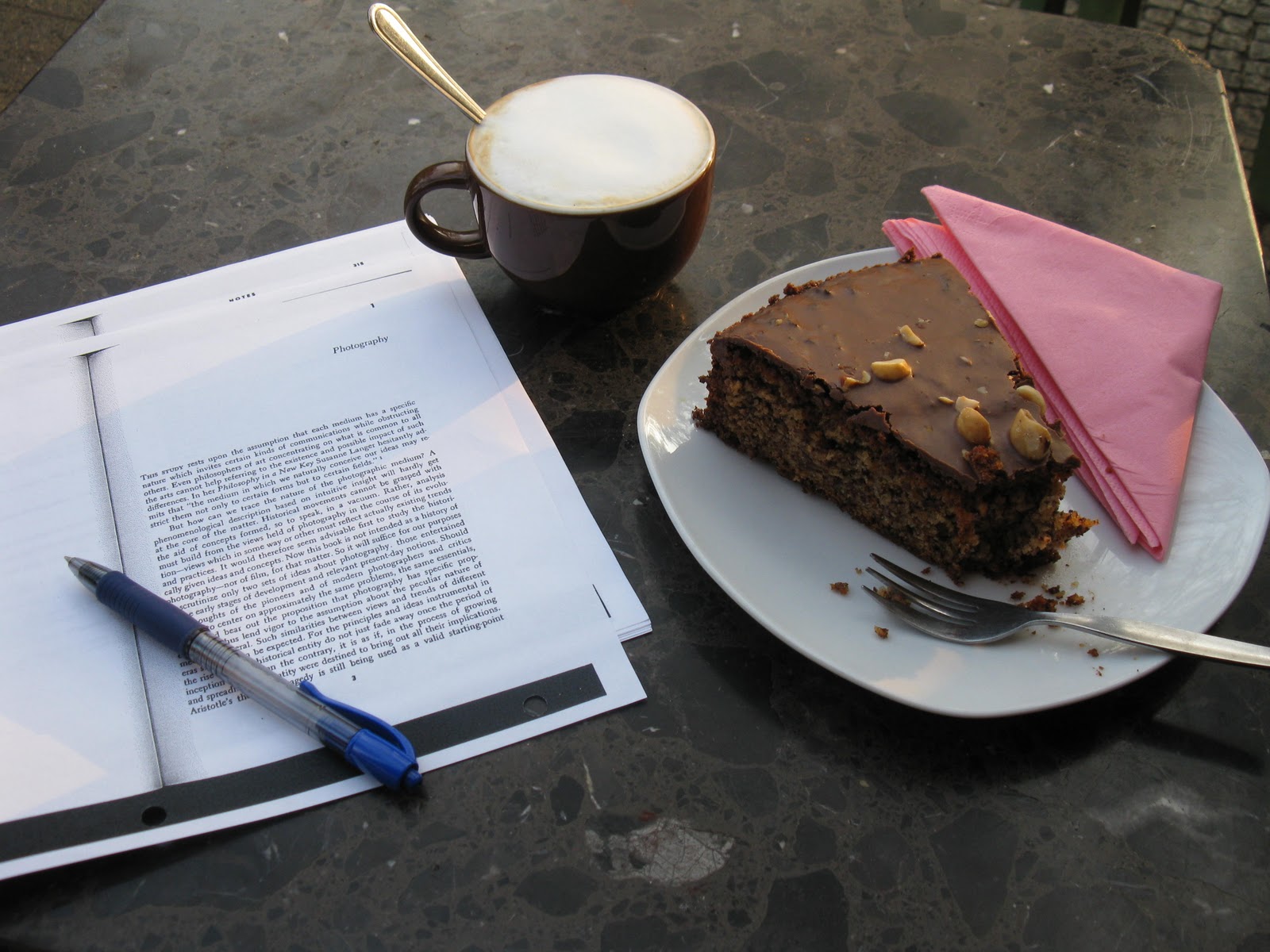
My bike ride to the library this afternoon happened to go past this bakery I have heard lots about and wanted to check out..."How convenient," as Michael said...
You order from a little window in the door, and sit outside. It was chilly, but I was warm from biking and bundled up, as were the 5 or so other people who were there when I was. Also, I heard some others coming and going, taking cake home, and someone ordering a torte for some event. It's a little treasure, this place!
This is what I got: Swiss Hazelnut-Kuchen. Delicious. Seriously.
Sunday, November 6, 2011
die Mode - fashion
I just finished watching a documentary about this East German fashion magazine called Sibylle. A friend of mine, another PhD student, is working on East German photography and I found it really fascinating.
As an East German publication, they had a small audience, limited travel opportunities (to Eastern bloc countries), and were supposed to present a certain image of women. One of the women in the documentary said that abstractly, their views harmonized very well with those of the party: they wanted to present working women who were well-educated and independent. But sometimes they had difficulties with the aesthetics of the images. The former editors who they interviewed said that usually they got away with what they wanted to do.
In general, the magazine was popular. It had a mix of fashion and culture, and the fashion photography was very artistic and avant-garde, especially during its beginning years in the 1960s. To move away from the posed models of the 1950s, they used more realistic, natural poses, and also women who weren't smiling, women moving. Here were some of my favorites. I couldn't find pictures of all of them on the web, but you get a sense. They're very beautiful images. Fashion photography is interesting. If you think about artistic photography, that sets a certain feeling or image, rather than necessarily portraying the clothing...I have seen some really whimsical and creative photo shoots in Anthropologie , for example, compared to catalogues like J Crew, that actually does show the clothing. And of course the major fashion magazines all have very elaborate and artistic photo shoots.
As far as "street fashion" vs high fashion, if you haven't yet discovered the blog The Sartorialist, it's amazing. The photographer shoots real people he sees out and about, being fashionable. This is also the technique of Bill Cunningham at the New York Times. Another documentary tip, if you haven't seen it yet, Bill Cunningham New York. watch a clip here. One of my favorite movies I saw last year.
As an East German publication, they had a small audience, limited travel opportunities (to Eastern bloc countries), and were supposed to present a certain image of women. One of the women in the documentary said that abstractly, their views harmonized very well with those of the party: they wanted to present working women who were well-educated and independent. But sometimes they had difficulties with the aesthetics of the images. The former editors who they interviewed said that usually they got away with what they wanted to do.
In general, the magazine was popular. It had a mix of fashion and culture, and the fashion photography was very artistic and avant-garde, especially during its beginning years in the 1960s. To move away from the posed models of the 1950s, they used more realistic, natural poses, and also women who weren't smiling, women moving. Here were some of my favorites. I couldn't find pictures of all of them on the web, but you get a sense. They're very beautiful images. Fashion photography is interesting. If you think about artistic photography, that sets a certain feeling or image, rather than necessarily portraying the clothing...I have seen some really whimsical and creative photo shoots in Anthropologie , for example, compared to catalogues like J Crew, that actually does show the clothing. And of course the major fashion magazines all have very elaborate and artistic photo shoots.
![]() |
| Arno Fischer |
![]() |
| Sibylle Bergemann |
![]() |
| Günter Rössler |
![]() |
| Günter Rössler |
![]() |
| Günter Rössler |
Labels:
DDR,
Mode,
photography
Saturday, November 5, 2011
lost in translation
My sister sent me a link to this post from ZsaZsa Bellagio that I wanted to re-post:
This list got me thinking.... You've probably heard of Schadenfreude, Zeitgeist, Gemütlichkeit, unheimlich, and there are tons of words from German philosophy that aren't easily expressed in English but I wanted to add some more German/English "untranslatable" terms that I encounter or think about more often, some of you will have heard these before...When terms are untranslatable, or not directly translatable, it's really interesting to think about the language philosophy, and why you can't express something the same way...and what it means about thinking and feeling if you don't have the same vocabulary to express something. oops I got a little carried away with this list, but I still feel like I'm forgetting the 10 things a day that come to mind! Obviously the list could be infinite...
ausschlafen - to "sleep out", slightly different meaning than the English "to sleep in", which usually means to sleep in late. You have time to sleep in on the weekend. The German ausschlafen means you got all the sleep you need. So you can get up at 6:00 and be super awake and someone can say with surprise, "Ausgeschlafen?" (slept out?)
awkward - no good German translation for this English word. Also in English "slang" it's become quite popular to call things awkward...Germans don't have this. The closest words are maybe unangenehm (uncomfortable) or komisch (strange).
ich habe dich lieb - In German there is more of a continuum to express like/love. You can say Ich mag dich, Ich habe dich lieb, Ich liebe dich. In English we don't have this second expression, which is literally "I have you dear", or "you are dear to me". It's used like "I love you" but less intense.
pumpkin, squash - In German they don't have a distinction between these...they have Zucchini and Kürbis but no other word. There are lots of examples like this, which just reinforces how arbitrary classification systems are! Are squash pumpkins, or pumpkins squash? Who decides? A similar thing is that in German they have multiple words for what we would call a "bug", including both Tier [animal, beast] and Käfer [bug, beetle]. It seems very strange to me to realize you have a bug crawling on you and say, "Bwah, ein Tier!"
Feierabend - it's the time when you get off work. So when you're leaving a business/shop/office in the late afternoon, you can say "Schönen Feierabend", enjoy your "quittin' time". :)
Freund, Bekannte - Related to the variations of "love," above. In English we use the term "friend" quite loosely, especially in this age of Facebook "friends." But in German they distinguish more between Freund and Bekannte, more like "acquaintance". Of course we have the word acquaintance in English, but I would never use it, like "oh I met up with an acquaintance of mine at the movie theater last night." I think we are quick to call people friends.
homemade - German has "hausgemacht" or "selbstgemacht" but doesn't have the same cozy ring to me
ein roter Faden - literally "red thread," a common theme or topic, something unifying a story or a film or a "thread" running through, giving continuity to something. So you can say "this talk had no 'red thread', I couldn't follow it"
schwimmen - also means "to float" in German. They have no separate word for inanimate things on the surface of the water... "Das Boot schwimmt auf dem See" the boat is swimming on top of the lake. "Fat floats," Fett schwimmt oben. :)
Ohrwurm- a word for "a song stuck in your head," as in Ich habe einen Ohrwurm, I have an "ear worm"! haha, when I first heard this I thought this woman actually had some kind of illness, some kind of bug in her ear...still makes me laugh!
Then there are nouns that have slightly different meanings, like Haus or Brot. If you live in an apartment building, that is also a Haus in German. I say "the facade of this Haus has lots of beautiful balconies," but you couldn't use the English "house" in that way. Also in German you talk about "a" bread, not usually a "loaf" of bread. So you can say "I would like a bread" or "2 breads", 2 Brote. Again, it's interesting to link language and culture, think about what it means about American culture (or German culture) that we have very different images of what a "house" is, something you think of as being so basic. What to Americans is the classic "house" picture Germans would specify as being a Einfamilien-Haus, a "one-family" house.
And for the real grammar freaks among you (I know some of you are...) there are also lots of English nouns that have German verbs, or vice-versa, or other parts of speech that don't line up. For example, in English we "have breakfast," and in German you use frühstücken, the verb. "I get up and then I breakfast," Ich stehe auf und dann frühstücke ich. And they have a verb for "shame" and not an adjective, "Ich habe mich geschämt," not "I was ashamed". Really interesting to think about what some of this constructions mean for the way you actually feel or express the feeling of a certain emotion.
This list is evidence of the difficulty of one-to-one translation...and why as a language instructor it's always frustrating when students expect there to always be an easy translation, or a noun-to-noun translation, or whatever. I think it reflects a deeper understanding of the way language works to realize that you have to think about different ways of expressing a feeling, a concept, a thing, or an idea. I think as a teacher it's something we should help our students to recognize, but it takes a while...I think (especially middle or high school students) they think we just don't know the word when we tell them they can't say it like that!
There are so many more examples I can't think of at the moment! German also has tons of composite nouns (hence the really really long words...), so you can also make up infinite number of combinations. That's why there is no "longest" word in the German language. They can keep getting longer and longer...I know German gets a bad reputation for sounding "harsh" and for being grammatically challenging, but once you really get into the language, you realize how creative it is, and how beautiful and poetic some of the composite nouns are.
Feel free to comment with more examples!
This list got me thinking.... You've probably heard of Schadenfreude, Zeitgeist, Gemütlichkeit, unheimlich, and there are tons of words from German philosophy that aren't easily expressed in English but I wanted to add some more German/English "untranslatable" terms that I encounter or think about more often, some of you will have heard these before...When terms are untranslatable, or not directly translatable, it's really interesting to think about the language philosophy, and why you can't express something the same way...and what it means about thinking and feeling if you don't have the same vocabulary to express something. oops I got a little carried away with this list, but I still feel like I'm forgetting the 10 things a day that come to mind! Obviously the list could be infinite...
ausschlafen - to "sleep out", slightly different meaning than the English "to sleep in", which usually means to sleep in late. You have time to sleep in on the weekend. The German ausschlafen means you got all the sleep you need. So you can get up at 6:00 and be super awake and someone can say with surprise, "Ausgeschlafen?" (slept out?)
awkward - no good German translation for this English word. Also in English "slang" it's become quite popular to call things awkward...Germans don't have this. The closest words are maybe unangenehm (uncomfortable) or komisch (strange).
ich habe dich lieb - In German there is more of a continuum to express like/love. You can say Ich mag dich, Ich habe dich lieb, Ich liebe dich. In English we don't have this second expression, which is literally "I have you dear", or "you are dear to me". It's used like "I love you" but less intense.
pumpkin, squash - In German they don't have a distinction between these...they have Zucchini and Kürbis but no other word. There are lots of examples like this, which just reinforces how arbitrary classification systems are! Are squash pumpkins, or pumpkins squash? Who decides? A similar thing is that in German they have multiple words for what we would call a "bug", including both Tier [animal, beast] and Käfer [bug, beetle]. It seems very strange to me to realize you have a bug crawling on you and say, "Bwah, ein Tier!"
Feierabend - it's the time when you get off work. So when you're leaving a business/shop/office in the late afternoon, you can say "Schönen Feierabend", enjoy your "quittin' time". :)
Freund, Bekannte - Related to the variations of "love," above. In English we use the term "friend" quite loosely, especially in this age of Facebook "friends." But in German they distinguish more between Freund and Bekannte, more like "acquaintance". Of course we have the word acquaintance in English, but I would never use it, like "oh I met up with an acquaintance of mine at the movie theater last night." I think we are quick to call people friends.
homemade - German has "hausgemacht" or "selbstgemacht" but doesn't have the same cozy ring to me
ein roter Faden - literally "red thread," a common theme or topic, something unifying a story or a film or a "thread" running through, giving continuity to something. So you can say "this talk had no 'red thread', I couldn't follow it"
schwimmen - also means "to float" in German. They have no separate word for inanimate things on the surface of the water... "Das Boot schwimmt auf dem See" the boat is swimming on top of the lake. "Fat floats," Fett schwimmt oben. :)
Ohrwurm- a word for "a song stuck in your head," as in Ich habe einen Ohrwurm, I have an "ear worm"! haha, when I first heard this I thought this woman actually had some kind of illness, some kind of bug in her ear...still makes me laugh!
Then there are nouns that have slightly different meanings, like Haus or Brot. If you live in an apartment building, that is also a Haus in German. I say "the facade of this Haus has lots of beautiful balconies," but you couldn't use the English "house" in that way. Also in German you talk about "a" bread, not usually a "loaf" of bread. So you can say "I would like a bread" or "2 breads", 2 Brote. Again, it's interesting to link language and culture, think about what it means about American culture (or German culture) that we have very different images of what a "house" is, something you think of as being so basic. What to Americans is the classic "house" picture Germans would specify as being a Einfamilien-Haus, a "one-family" house.
And for the real grammar freaks among you (I know some of you are...) there are also lots of English nouns that have German verbs, or vice-versa, or other parts of speech that don't line up. For example, in English we "have breakfast," and in German you use frühstücken, the verb. "I get up and then I breakfast," Ich stehe auf und dann frühstücke ich. And they have a verb for "shame" and not an adjective, "Ich habe mich geschämt," not "I was ashamed". Really interesting to think about what some of this constructions mean for the way you actually feel or express the feeling of a certain emotion.
This list is evidence of the difficulty of one-to-one translation...and why as a language instructor it's always frustrating when students expect there to always be an easy translation, or a noun-to-noun translation, or whatever. I think it reflects a deeper understanding of the way language works to realize that you have to think about different ways of expressing a feeling, a concept, a thing, or an idea. I think as a teacher it's something we should help our students to recognize, but it takes a while...I think (especially middle or high school students) they think we just don't know the word when we tell them they can't say it like that!
There are so many more examples I can't think of at the moment! German also has tons of composite nouns (hence the really really long words...), so you can also make up infinite number of combinations. That's why there is no "longest" word in the German language. They can keep getting longer and longer...I know German gets a bad reputation for sounding "harsh" and for being grammatically challenging, but once you really get into the language, you realize how creative it is, and how beautiful and poetic some of the composite nouns are.
Feel free to comment with more examples!
Labels:
language
Friday, November 4, 2011
European Investment Prospectus
funny video:
The Colbert Report
Get More: Colbert Report Full Episodes,Political Humor & Satire Blog,Video Archive
Labels:
Politik
Wednesday, November 2, 2011
ein gelber Herbst
Sorry, not a lot of posting lately, been going to the archive and to the library (photo left), and to talks/lectures...Which has all been great, although tiring.
Today I biked to the library and stopped and took some photos along the way. I've usually been taking the U-Bahn, but it was really refreshing to be out on my bike, looking around and seeing things.
The weather is starting to get a bit cooler, although not cold...And the leaves are still turning, and falling. Berlin doesn't really have the deep oranges or reds that we have in Minnesota and Michigan, but it's more of a "yellow autumn".
Happy November!
Today I biked to the library and stopped and took some photos along the way. I've usually been taking the U-Bahn, but it was really refreshing to be out on my bike, looking around and seeing things.
The weather is starting to get a bit cooler, although not cold...And the leaves are still turning, and falling. Berlin doesn't really have the deep oranges or reds that we have in Minnesota and Michigan, but it's more of a "yellow autumn".
Happy November!
Subscribe to:
Posts (Atom)