Showing posts with label cultural differences. Show all posts

Thursday, May 10, 2012

Random (hopefully interesting) facts

garbage cans in Berlin with little word plays
1. In Germany, you can buy milk with fat percentages: 1.5%, 3.5%, 3.7%.
(No "skim," 1%, or 2%.)

2. Germans say "Ah-chi!" [spelled "hatschi" in comics, etc] when they sneeze, not "ah-choo". Seriously.

3. On German TV, there is a warning on the screen before the show if there is product placement: "Unterstützt durch Produktplatzierung

4. The stop lights are on the other side of the street here. In the US, they are on the oppose side of the street, so you can pull right up to the intersection. In Germany, they are on your side of the intersection, so you have to back up behind the crosswalk in order to see them. 

5. In Germany you only pay (or get charged "minutes") when you make phone calls and place text messages, not for receiving calls or messages. I wonder if the difference is that the US has such a huge area...otherwise it doesn't really make sense. 

6. "Oil of Olay" (the brand) is called "Olaz" in Germany. By strange coincidence (?), the Y and Z are swapped on the German keyboard. (so when zou tzpe with the German kezboard it looks like this...) Michael's theory about Olay-Olaz: it's a typo. :)


7. NO public drinking fountains here. The only city I have ever seen with a drinking fountain is Hamburg, they have a few outdoor ones. But in the library I have seen students with their heads under the faucet in the bathrooms, getting a drink!! It's crazy! In the US you can plan long runs around parks that have water fountains...not in Germany. Don't expect one at the gym, the university, wherever. Nope. 


8. In Germany you can control the amount of water you use to flush the toilet...very environmentally friendly. :)

Friday, March 30, 2012

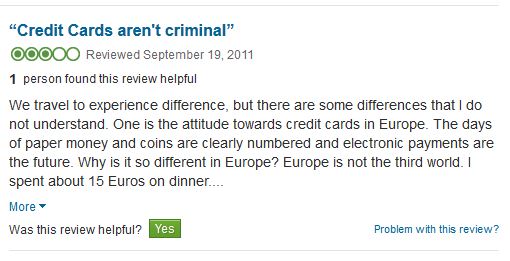
"Europe is not the third world..."


"Europe is not the third world..." haha! I came across the above review on "Trip Advisor" while planning a trip on the Rhine for when my mom and grandmother come to visit. (P.S. Also came across this beautiful English on the same page: "We road a choo choo tram that stopped directly in front of our hotel uphill to the castle". Yes: we "ROAD" a train.) Interesting how according to this guy (he seems like a guy to me...) America is in the "future" and Europe is stuck in old ways (even "third world" ways). At least he admits that it's a difference he doesn't understand.

The photo to the left is a restaurant down the street from us. On the blackboard it says: "Dear guests, we do not accept any EC card or Visa cards, Danke." Most smaller restaurants only accept cash, and these are the kinds of places you want to eat at when you're traveling and experiencing Europe! (Also smaller hotels will only accept cash, or sometimes bank transfer. Again: these are probably nicer and have more character than the chains that accept credit cards!)

It's a big cultural difference: Americans like their plastic. We're used to using cards for everything. But sorry, when you come to Europe you need to carry cash. I know it's inconvenient with the currency transfer and everything, but it's a big difference between the US and Germany (I won't speak for the rest of Europe here, but maybe it's valid most places). They have a lot more smaller, local and family-owned businesses and shops, and credit card machines rack up fees. It's also symptomatic of a larger difference between American culture and European culture (I think): In the US everything is consumer-centered, please the customer, and in Europe it's also more centered on the employers and workers (I think having Sundays and holidays off is another example of this). And is it not possibly also a sign of our credit economy? That we are used to using plastic forms bad spending habits...and maybe the German tendency to pay in cash also helps people be more aware of their spending limits? This is speculation...What do you think?

On a side note: Most grocery stores and drugstores will accept cards, but often only the more technologically advanced European cards, that have a computer chip in them. They think American cards are very unsafe and old-fashioned (just with the magnetic strip). If you're traveling in Germany, it's good to know that bigger grocery stores like Kaisers or Rewe will take credit cards. Otherwise, in most stores (and also vending machine-type things) you have to have the chip! For example, buying train tickets from a machine.

Another side note: The review above says that "electronic payments" are the way of the future. In this way, Germany is waaay more advanced than the US! I think I've mentioned before how people use bank transfers here for anything and everything, and it's super super easy to pay bills. You can also pay private persons with online banking. No one writes checks for anything anymore! 

Tuesday, March 13, 2012

Ode to Tempo Taschentücher

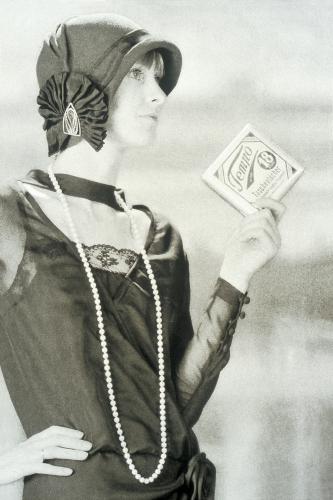
Berlin, 1929, an early ad
 So for the last two weeks I've had a bad cold on-and-off, so I thought I would do a strange little post about the German version of Kleenex, called "Tempo" (but superior to its American version). Like in English, people reference the thing by the brand name (Kleenex/Tempo) maybe just as often as the generic word "tissue" or "Taschentuch".

A cultural difference (but correct me if I'm wrong): My impression is that in the US, people tend to buy boxed tissues more than the small kind. If you go to a drugstore or grocery store, there is a whole shelf with lots of options for boxed tissues: colored tissues, with lotion, with aloe, etc. But Germans have mastered the pocket tissues. But the pocket sized ones are usually flimsy and cheap in the US, and the German ones are super strong. And, in Germany almost everyone always has a pack of tissues on them, that look like the blue pack below.

It's funny if you think about the cultural meaning of this revolution: from fabric handkerchiefs to paper tissues (diapers, too...). In Germany this brand was introduced in 1929; in the US Kleenex was also being developed and marketed in the mid 1920s. At first it was being used to remove makeup, and then after the 30s it is marketed as a hygiene product, with the slogan: “Don’t Carry a Cold in Your Pocket”.  Below is a similar ad/slogan from Tempo: "Higher Risk of Flu - Tempo, the hygienic tissue. " (here More ads from Spiegel)  So that's the weird little post for you as I sit in bed, recovering with my Tempos. :) Germany isn't the worst place to have a cold...as they also have the best juice (Multivitaminsaft) and Ricola! (Jessica knows what I'm talking about here...)